Equatorial Margin raises alarms over external threats - Valor International
In late October, when Petrobras announced its third oil discovery in an ultradeepwater area off the coast of Amapá, expectations within the company rose further that a long-awaited prospect would be confirmed: the Equatorial Margin may indeed contain a large, commercially viable reserve of high-quality oil.
Petrobras estimates that the seabed in the region—where water depths exceed 2,800 meters in some locations—may hold at least 30 billion barrels of oil.
As exploration advances and investor optimism grows, however, concern is mounting among defense experts. They are asking how Brazil plans to protect this strategic region from potential external threats.
“The world is different today. Scenarios we considered absolutely impossible a few years ago are now merely unlikely,” said Jackson Schneider, an advisor to the Brazilian Center for International Relations (Cebri).
He was referring to new tensions and disputes, including those between the United States and countries that Americans until recently regarded as unquestioned allies.
“That is without even mentioning the proliferation of structural insecurity around the world. When you have the prospect of developing the Equatorial Margin amid insecurity—including energy insecurity—you have an asset that needs to be protected,” said Schneider, who maintained dialogue with members of several countries’ armed forces during more than ten years as president of Embraer Defense & Security.
He also spent two years in the Department of War Studies at King’s College London and two years at Columbia University’s School of International and Public Affairs in New York.
Described as a potential new pre-salt province or Brazil’s newest offshore oil frontier, the Equatorial Margin is a 2,200-kilometer stretch of the Atlantic extending from the coast of Amapá to Rio Grande do Norte. It lies alongside producing offshore fields near French Guiana, Suriname, and Guyana.
Brazilian environmental agencies raised numerous questions and made a series of demands of Petrobras before granting the company approval—under strong government pressure—to begin exploratory drilling.
Petrobras’s 2026-2030 Business Plan provides for $7.1 billion in exploration investments in new oil areas. The largest share, 37.5%, is earmarked for the Equatorial Margin, where Petrobras plans to drill 15 wells by 2030. For now, drilling and discoveries are confined to a single well, Morpho, off the coast of Amapá. It is the first of the 15 wells planned for the Equatorial Margin through 2030.
For military officials and defense experts, the prospect of substantial energy resources in a remote area that is far less closely monitored than the Southeast’s pre-salt fields should raise alarms about potential threats.
One such threat is drone attacks on offshore oil installations—similar to the attacks this month against a hydroelectric plant in Colombia or those carried out by Russia and Ukraine.
Another scenario would involve a country blocking access to the Equatorial Margin if its relations with Brazil entered a downward spiral of disputes.
In an extreme future marked by an oil crisis and conflict with Brazil, another country—or several countries—could also attempt to seize control of production.
Other potential threats include attacks and sabotage by transnational criminal organizations against vessels or future offshore bases. Drug-trafficking groups already operate along Brazil’s northern and northeastern coasts, making Atlantic crossings with cocaine shipments bound for Europe.
The question is how to respond to an uncertain range of possible threats to an area that could become so critical.
“We have a limitation that I consider extremely troubling from a strategic standpoint: Brazilian naval power is concentrated in Rio de Janeiro,” said Leonardo Mattos, a geopolitics professor at the Naval War College and coordinator of the institution’s Center for Strategic Assessment and Analysis.
He was referring to the vessels that make up Brazil’s fleet and provide its strongest capacity to confront threats from potentially hostile foreign powers. They include the multipurpose aircraft carrier Atlântico, Latin America’s largest warship, as well as submarines, frigates, and other vessels. All are based in Rio de Janeiro.
Brazil has warships stationed along the coast outside Rio de Janeiro, but they have less combat capability.
“To provide an immediate response in the Equatorial Margin to a serious potential threat from a foreign power, or to any action against our oil platforms, a frigate leaving Rio de Janeiro would take ten days to reach the mouth of the Amazon River and the waters off Amapá. Ten days at sea,” Mattos explained.
Nearly two decades ago, an idea gained traction within the Brazilian Navy’s leadership: creating a second fleet. The new fleet would expand Brazil’s defense capabilities in northern and northeastern waters. The proposal, however, never got off the drawing board.
Now that the Equatorial Margin could become a highly strategic energy asset, support for a second fleet is growing again. Mattos, a retired Brazilian Navy captain, is among its advocates.
Defense Minister José Múcio also supports the view that Brazil would benefit from a second fleet to protect the Amazon River mouth and the Equatorial Margin. The proposal, however, runs up against federal budget constraints, which already affect the country’s only fleet. In practice, a new fleet is therefore not currently under consideration.
Schneider sees another path. Given today’s potential threats and forms of warfare—including drones, cyberattacks, sabotage, and other actions—a second fleet might not be the most appropriate response, he noted.
“We need to think, plan, and analyze responses to current threats. This is not the time to anticipate a response or present a finished formula,” Schneider explained. “The question is how to protect a potential asset from some threats we already understand and others whose nature we cannot yet foresee. We are living in a world in transition.”
The Brazilian Navy is already on alert over potential threats. “The Navy has been working to strengthen its presence in the Equatorial Margin to reinforce the protection of national interests in this strategic area,” the force told Valor in a statement.
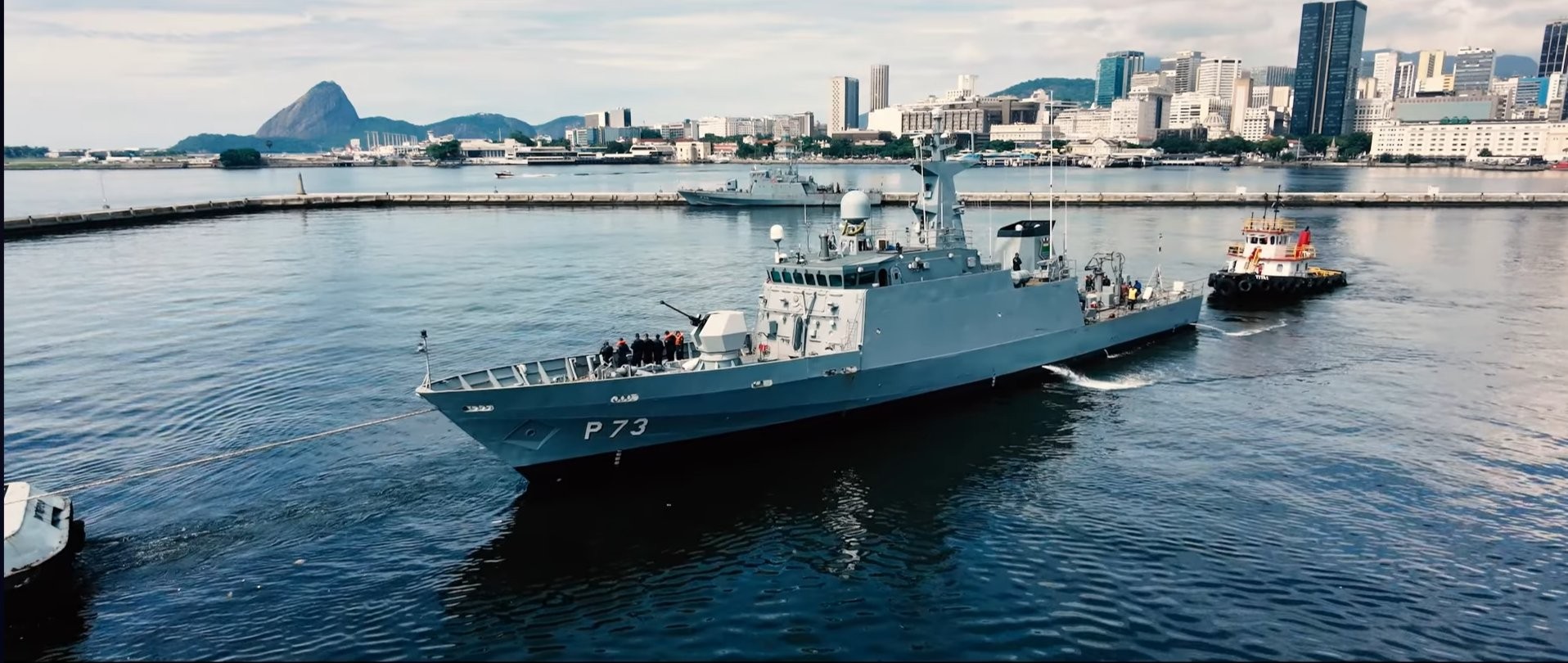
On October 30, a new patrol ship, the Mangaratiba P73, was commissioned into the Navy to operate around the Amazon River mouth and the Equatorial Margin. The force also said it is seeking to strengthen its monitoring capacity through the Blue Amazon Management System and other initiatives.
The Maritime Defense Strategy (EDM) designates the Equatorial Margin and the Amazon River mouth as priority maritime areas for the Navy.
In its statement, the Navy noted that the Equatorial Margin’s growing importance means greater demand for resources and investment to “maintain an effective presence in the region, preserve deterrence capabilities, and ensure operational readiness.”
It added: “The Navy’s role extends beyond inspection and navigational safety to encompass the defense of natural resources, the protection of critical offshore infrastructure, the monitoring of maritime areas of national interest, and the maintenance of rapid-response capabilities against potential threats.”
The Brazilian Air Force (FAB), meanwhile, said it maintains a permanent presence in the North and in the airspace over waters under Brazilian jurisdiction, including the Amapá coast and the Equatorial Margin.
“In the Equatorial Margin, as throughout the country, the FAB continues uninterruptedly to fulfill its mission of safeguarding the sovereignty of Brazilian airspace and integrating the national territory,” the force said in a statement.
Asked about the issue, Petrobras said it maintains preventive security measures at all its assets in the region through its corporate intelligence and security department.
“These measures cover the security of facilities supporting operations, including the airport infrastructure used by Petrobras, as well as the transportation of employees and contractors to Oiapoque,” the company noted, adding that it does not disclose details of its security procedures for safety reasons.