DPM Dar says Pakistan’s natural resources could be worth up to $10 trillion - The Express Tribune
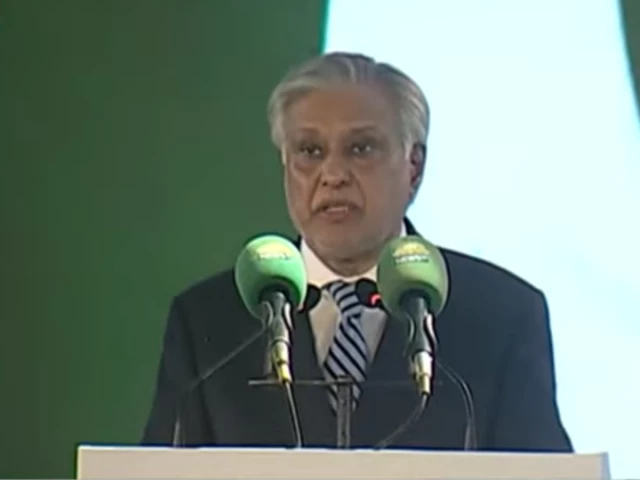
Deputy Prime Minister and Foreign Minister Ishaq Dar said Pakistan’s natural resources, including minerals, hydrocarbons and gemstones, were conservatively estimated to be worth between $8 trillion and $10 trillion, as he welcomed a Turkish seismic research vessel at Karachi Port on Friday.
Addressing a ceremony marking the arrival of the Turkish vessel Oruç Reis in Karachi, DPM Dar said, “Sometimes people talk about Pakistan being a heavily indebted country or a debt-trap country. I always negate [that]. The total debt of Pakistan, the Government of Pakistan, is about $100 billion. If you include the liabilities in foreign exchange of private companies and public sector enterprises, the total amount is $130 billion.”
“The most conservative estimate of the things I counted — the mines and minerals, natural resources, hydrocarbons, gemstones and other God-gifted natural resources in this country — is anything between $8 trillion and $10 trillion.”
The deputy prime minister said the arrival of the vessel marked “a new chapter of scientific exploration and strategic cooperation” between Pakistan and Turkey, built on the two countries’ longstanding friendship.
“On behalf of the Prime Minister Shehbaz Sharif, our government and the people of Pakistan, I convey our deepest gratitude to Turkish President Recep Tayyip Erdogan, and to my brother, Foreign Minister of Turkey, Mr Hakan Fidan, for their personal commitment to strengthening relations between Pakistan and Turkey,” he said.
He also welcomed Turkey’s Minister of Energy and Natural Resources, Alparslan Bayraktar, and thanked the Turkish government and people for standing alongside Pakistan.
“The bond between Pakistan and Turkey predates the establishment of Pakistan itself, with roots in the solidarity extended by the Muslims of South Asia to the Turkish people during defining moments in their history,” Dar said.
Addressing the ceremony welcoming the Turkish seismic research vessel Oruc Reis at Karachi Port, Deputy Prime Minister Ishaq Dar says Pakistan seeks a long-term partnership with Turkiye in minerals exploration, describing the growing cooperation as the highest tribute to the two… pic.twitter.com/wShYT9V126
“Since then, our peoples have stood together through tough times of trial and triumph. The highest tribute we can pay to our shared past is to convert that spirit into opportunities for our peoples," the deputy prime minister added.
The Oruç Reis will bring together Turkish scientific expertise and the experience of Pakistan’s national energy companies to conduct advanced exploration in the country’s offshore domain, he said.
“Every successful journey of exploration begins with knowledge. The data gathered by this vessel may deepen our understanding of the geological structures beneath the seabed and provide a stronger basis for Pakistan’s future exploration plans,” Dar said.
He acknowledged the uncertainty involved in offshore exploration, saying: “Offshore exploration is complex, capital-intensive and inherently uncertain. A seismic survey cannot guarantee a commercial discovery, but no discovery can be made without seismic and exploration.”
Pakistan was taking that step with confidence and responsibility, he added.
“Their maritime domain offers opportunities in energy, shipping and fisheries. A vibrant blue economy requires reliable scientific data, skilled human resources and environmental safeguards," DPM Dar said.
Deputy Prime Minister and Foreign Minister Ishaq Dar addresses the ceremony marking the arrival of Türkiye’s seismic research vessel Oruç Reis at Karachi Port, highlighting the growing Pakistan–Türkiye partnership in energy cooperation and offshore oil and gas exploration.… pic.twitter.com/XFLOg5M6Ry
The minister added that the prime minister had directed relevant federal ministries and institutions to strengthen coordination on a fast-track basis. “Our government is firmly committed to ensuring that projects of strategic importance will not suffer from institutional fragmentation or unnecessary delay,” he said.
DPM Dar outlined Pakistan’s ambition to build a long-term energy partnership with Turkey covering offshore exploration, minerals and renewable energy. He referred to three memorandums of understanding signed between the relevant Pakistani and Turkish agencies.
“We want Pakistani geologists and engineers to work very closely with their Turkish counterparts. We want our universities and research institutions to develop partnerships in marine science, geoscience and offshore engineering,” he said.
He added that cooperation between the two countries already covered diplomacy, defence and trade, and called for their strategic understanding to be matched by a stronger economic partnership.
“Security in the modern age is multidimensional. It is the security of our borders and our people. It is also the security of energy supplies, trade routes and critical infrastructure,” Dar said.
Live: Welcome ceremony for Turkish seismic research vessel https://t.co/tXccA6mVeG
Referring to a recent meeting in Antalya between PM Shehbaz and the Turkish President, he said the two leaders had reaffirmed their determination to accelerate cooperation in trade, investment, defence, energy and connectivity.
“They also agreed on the need for faster implementation of ongoing initiatives,” he said. “Pakistan and Turkey have never lacked goodwill. Our responsibility now is to match that goodwill with practical results.”
Dar said Pakistan was open to long-term investment and welcomed partners bringing capital, expertise and a commitment to the country’s development.
“In return, our government is committed to transparency and policy continuity,” he said, adding that Pakistan was pursuing economic reforms and engaging with major international institutions to strengthen investor confidence.
“I assure our Turkish partners that the Government of Pakistan will extend every appropriate facilitation to this very important mission,” he said.
The deputy prime minister highlighted that, "Our seas are an economic asset, but they are also a national trust. Development and environmental stewardship must proceed together."
DPM Dar thanked the Petroleum Minister Ali Pervaiz Malik, the petroleum secretary and their teams, as well as Pakistan’s and Turkey’s national energy companies, the armed forces, particularly the navy, and the Sindh government for supporting the mission. He also acknowledged the contribution of maritime, port, and law enforcement agencies and Pakistani and Turkish professionals involved in the project.
“I told our brother, the energy minister from Turkey, that this seismic survey would take about five to six months. I said, ‘You won’t be allowed to leave unless you give us good news of a real discovery’,” the minister comically stated.
He expressed hope that the mission would lead to Pakistan’s first successful offshore drilling and exploration. “That day is not too far when Pakistan will be having its first successful offshore drilling and exploration.”
“May this mission deepen our scientific understanding, strengthen our national capabilities and open new avenues of cooperation between Pakistan and our brotherly country, Turkey,” the deputy prime minister concluded.
Earlier, addressing the same ceremony, the Turkish energy and natural resources minister said the seismic research vessel Oruç Reis would collect three-dimensional (3D) seismic data across 670 square kilometres of Pakistan’s Indus offshore basin, with exploration operations in identified fields targeted for 2027.
Bayraktar said it had arrived to assess the potential of the Indus and Makran basins, following agreements signed between the two countries in Islamabad last year.
He said a partnership had been established between Turkish Petroleum Corporation (TPAO) and Pakistan’s national energy companies — Oil and Gas Development Company Limited (OGDCL), Pakistan Petroleum Limited (PPL) and Mari Energies. Licensing processes had been completed for five blocks, comprising three offshore and two onshore blocks, and operations had begun.
“Based on the data that we are going to collect here, we aim to launch operations in the identified fields, Inshallah, next year in 2027,” Bayraktar said.
He expressed hope that the survey would lead to discoveries that would contribute to the development of both countries.
Bayraktar thanked PM Shehbaz, Chief of Defence Forces and Chief of Army Staff Field Marshal Asim Munir, Petroleum Minister Malik, Pakistani officials and technical teams for their support. He also acknowledged the Turkish and Pakistani navies for escorting the vessel during its voyage.
Describing the mission as strategically important amid disruption in global oil and gas markets, he said cooperation in Pakistan’s onshore and offshore fields would strengthen energy security and contribute to national prosperity.
Bayraktar cited Turkey’s experience in offshore exploration, recalling that it had discovered major natural gas reserves in the Black Sea in 2020 using seismic and drilling vessels. “That was the largest offshore discovery of the global market in 2020,” he said.
Turkey was currently producing around 10 million cubic metres of gas from those fields, supplying approximately four million households, he added. The country aimed to increase production to 40 million cubic metres, enough to supply 14 million households.
Bayraktar said Turkey had brought the experience, expertise and engineering capabilities gained from those operations to Pakistan. He identified energy, power and mining as areas with further potential for cooperation, adding that additional agreements between the countries’ national mining companies and institutions would be signed at the ceremony.
He expressed hope that the partnership would lead to projects that would shape energy markets, bilateral trade and the economies of both countries.
According to the Turkish Ministry of Energy and Natural Resources, the Turkish seismic research vessel Oruç Reis is a specialised survey ship equipped to collect seismic data from beneath the seabed to assess the potential presence of offshore oil and gas reserves.
During its mission in Pakistan, the vessel is expected to conduct surveys in the Indus and Makran offshore basins, gathering geological data that could help identify areas for future exploration and drilling. The survey will include 3D seismic data collection over an area of 670 square kilometres in the Indus-C Block, followed by 2D seismic surveys covering 2,353 kilometres of survey lines in the Makran blocks.
The Offshore Bid Round 2025 was launched in January last year after an 18-year hiatus, offering exploration licences for 40 offshore blocks in the Indus and Makran basins off Sindh and Balochistan.
Türkiye's national oil company, Turkish Petroleum Corporation (TPAO), secured a 25 per cent stake and operatorship in Offshore Block-C, signalling growing international interest in Pakistan's offshore hydrocarbon potential.
A recent basin study by US-based consultancy DeGolyer and MacNaughton (D&M) indicated substantial unexplored hydrocarbon potential in Pakistan's offshore basins, particularly in the Indus and Makran regions. Building on the findings, the government invited companies to explore various geological prospects in the areas.
Companies have committed 4,427 work units for the first phase of the initial three-year licence period, involving planned expenditure of around $80 million. During this period, they will undertake geological and geophysical studies, including seismic data acquisition and interpretation.
If initial findings are encouraging and exploration drilling proceeds, total investment under the programme could rise to between $750 million and $1 billion, according to the Petroleum Division.
Comments are moderated and generally will be posted if they are on-topic and not abusive.
This material may not be published, broadcast, rewritten, redistributed or derived from. Unless otherwise stated, all content is copyrighted © 2026 The Express Tribune.